Complete Guide to Recurring Deposit (RD) Calculation in India
A Recurring Deposit (RD) is an investment scheme offered by Indian banks and the Post Office that allows individuals to build wealth through disciplined monthly savings. Unlike a Fixed Deposit (FD) which requires a large upfront lump-sum payment, an RD account calculator lets you deposit a fixed amount every month while earning compounding interest rates comparable to long-term FDs.
1. How is RD Interest Calculated? (Quarterly Compounding Formula)
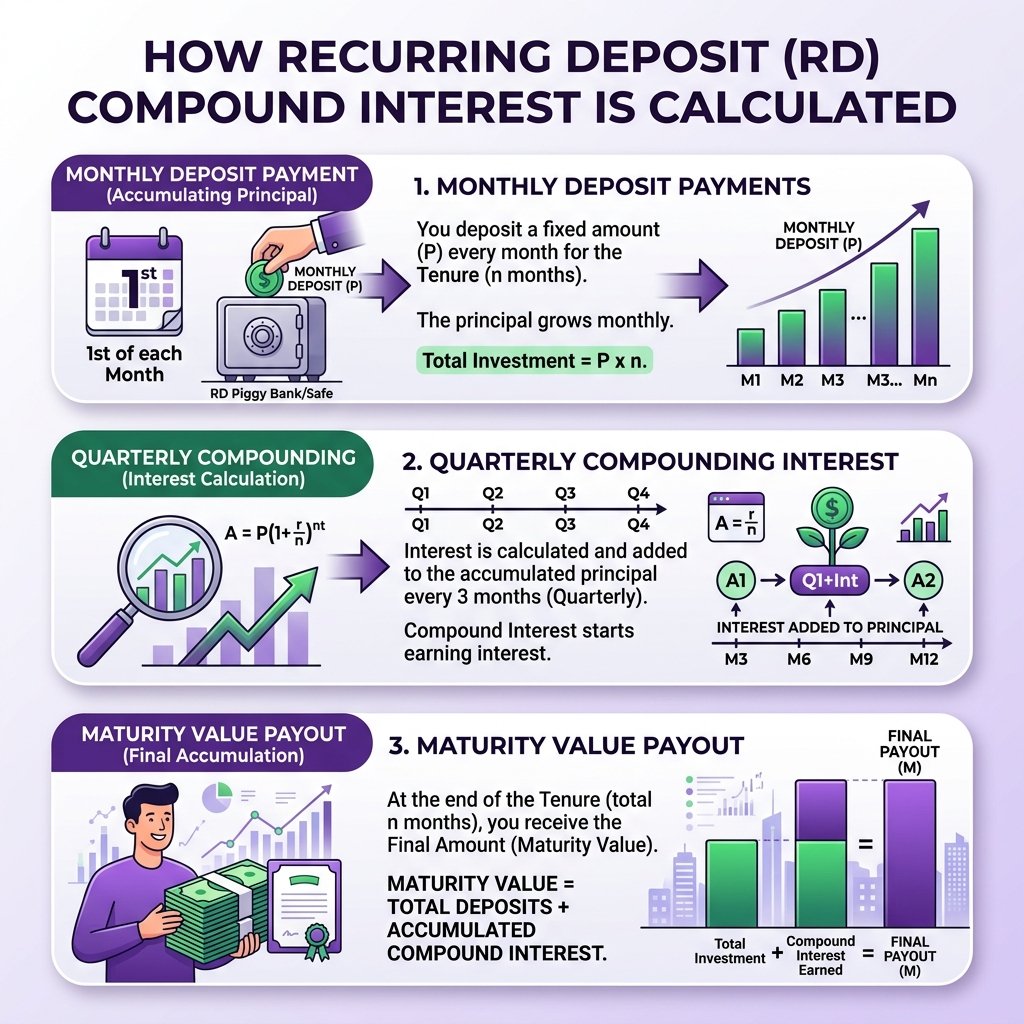
Many investors wonder how is RD interest calculated in major Indian financial institutions like SBI, HDFC Bank, ICICI Bank, and Post Office. Under Nationalized and Private banking guidelines, Recurring Deposit interest is compounded quarterly.
The mathematical formula used by our recurring deposit calculator to compute total maturity value is:
- M: Maturity Value of the Recurring Deposit.
- R: Monthly Installment Amount deposited each month.
- n: Total tenure of the deposit in quarters (Number of Months ÷ 3).
- i: Quarterly Interest Rate (Annual Rate ÷ 400).
Because each monthly installment stays in the bank for a different duration, earlier installments earn compound interest for a longer period than later deposits.
2. Bank RD Interest Rates Comparison (Post Office, SBI, HDFC, ICICI, Axis)
Comparing interest rates across different commercial and public sector institutions ensures maximum yield on your monthly savings:
| Financial Institution | Standard Rate (p.a.) | Senior Citizen Rate (p.a.) | Tenure Range | Key Features |
|---|---|---|---|---|
| Post Office (National Savings Scheme) | 6.70% | 6.70% | 5 Years (Fixed) | 100% Sovereign Guarantee by Govt. of India. Quarterly compounding. |
| SBI (State Bank of India) | 6.50% - 7.00% | 7.00% - 7.50% | 12 to 120 Months | High safety, flexible tenure, seamless SBI YONO app integration. |
| HDFC Bank | 7.00% - 7.25% | 7.50% - 7.75% | 6 to 120 Months | Highest short-term rates for 15-24 month tenures. Instant online setup. |
| ICICI Bank | 6.70% - 7.10% | 7.20% - 7.60% | 6 to 120 Months | iMobile instant RD creation, flexible premature withdrawal terms. |
| Axis Bank | 6.70% - 7.20% | 7.20% - 7.70% | 6 to 120 Months | Competitive digital interest rates with automatic monthly sweep features. |
3. Using the RD Calculator in Months vs. Yearly RD Calculator
Short-Term Goals: RD Calculator in Months
If you are saving for short-term financial targets such as an annual insurance premium, festival shopping, or a vacation, setting your tenure in months (e.g., 6, 12, 15, or 18 months) provides exact maturity projections without rounding errors.
Long-Term Projections: Yearly RD Calculator (Up to 40 Years)
For long-term financial planning such as child education or retirement corpus building, select years in the unit dropdown. While banks in India cap single RD contracts at 10 years, investors routinely rollover matured RDs into new contracts. Our calculator lets you project compounding returns up to 40 years!
4. RD vs. FD vs. SIP: Which Option Suits You Best?
- RD (Recurring Deposit): Ideal for risk-averse investors with regular monthly salary income who want guaranteed fixed returns.
- FD (Fixed Deposit): Best for investors who already possess a lump-sum amount and wish to lock in fixed interest rates immediately.
- SIP (Mutual Fund Systematic Investment Plan): Better suited for long-term wealth creation (5+ years) if you can tolerate market volatility for inflation-beating equity returns.
5. Tax Rules on Recurring Deposits (TDS Guidelines)
Interest earned on Recurring Deposits is subject to Tax Deducted at Source (TDS) under Section 194A of the Income Tax Act:
- TDS Threshold Limit: If your total interest earned across all RD and FD accounts in a bank exceeds ₹40,000 in a financial year (₹50,000 for senior citizens), the bank deducts 10% TDS.
- Form 15G / Form 15H: If your total taxable income is below the basic tax exemption limit, submit Form 15G (or Form 15H for senior citizens) to your bank to prevent TDS deduction.