- 1. How to Calculate Your Last Working Day
- 2. 90 Days Notice Period Calculator Rules in IT (TCS, Infosys, Wipro)
- 3. Notice Period Buyout Formula & Salary Rules
- 4. How to Calculate Last Working Date in Excel Formula
- 5. Indian Labor Laws & Legal Rights During Exit
- 6. Professional Resignation Email Templates
- 7. Frequently Asked Questions (FAQs)
1. Step-by-Step Guide: How to Use the Last Working Day Calculator
Submitting your resignation is an important career milestone. However, calculating your official Last Working Day (LWD) is crucial to ensure clean exit documentation, clear full & final (F&F) settlement, and a smooth onboarding transition with your next employer.
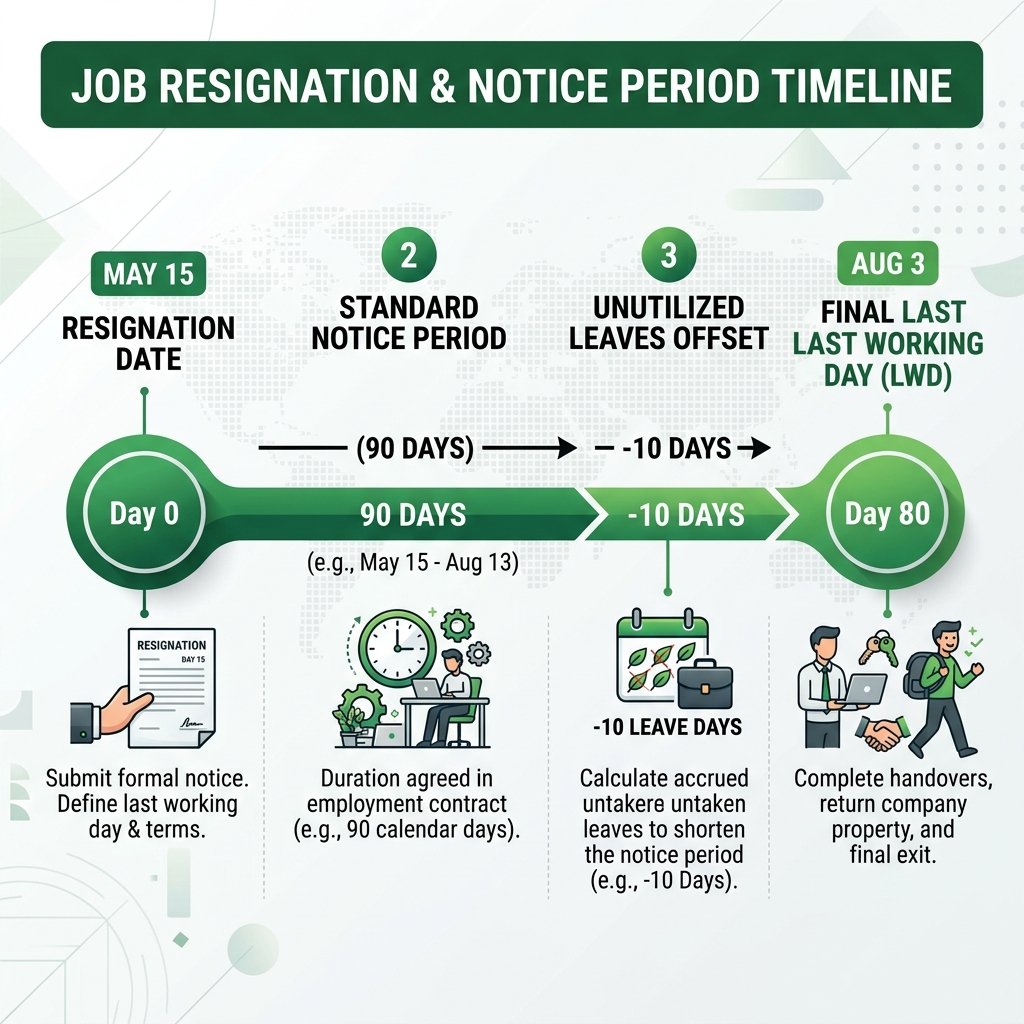
Step 1: Identify Official Date of Resignation
Your official notice period begins on the day you send your formal resignation email to your reporting manager and HR team (or log it in your HR portal like Darwinbox, SuccessFactors, or Workday).
Step 2: Add Standard Contractual Notice Period
Refer to your employment appointment letter or company HR handbook. Standard notice durations in India typically range from 30 days to 90 days (3 months). In standard calendar day calculations, Saturdays, Sundays, and public holidays are included.
Step 3: Deduct Approved Unutilized Leaves (EL/PL Offset)
If your employer permits Earned Leave (EL) or Privilege Leave (PL) offsetting, deduct your approved leave balance from your notice period. For instance, if you have a 90-day notice and offset 15 EL leaves, your actual required serving time drops to 75 days.
Step 4: Calculate Buyout Penalty for Early Exit (If Applicable)
If your new company requires an immediate join date and your current manager agrees to an early release, use our Last Working Day Calculator above to determine the exact notice buyout recovery amount based on per-day basic or gross salary.
2. 90 Days Notice Period Calculator Rules Across Indian IT Giants
Notice period requirements vary significantly depending on corporate policy, company size, and employee position. Below is a detailed breakdown of standard notice policies across major Indian employers:

| Company Category | Standard Notice Period | Probation Notice | Buyout Waiver Policy |
|---|---|---|---|
| IT Services Giants (TCS, Infosys, Wipro, Accenture, Cognizant) | 90 Days (3 Months) | 15 to 30 Days | Strict policies; early buyout requires project manager & Delivery Head sign-off. |
| Product MNCs & Startups (Google, Amazon, Flipkart, Swiggy) | 30 to 60 Days | 15 to 30 Days | Flexible; new employers frequently sponsor notice buyout penalties. |
| Banking & Financial Institutions (HDFC, ICICI, SBI) | 30 to 90 Days | 30 Days | Requires strict audit clearance and hand-over signoff prior to exit. |
| Government & Public Sector (PSU) | 1 to 3 Months | 30 Days | Strict adherence to service rules; buyout rare without official NOC. |
| US / Remote Employers | 14 to 30 Days (2 - 4 Weeks) | 7 to 14 Days | At-will employment standard; flexible exit terms. |
3. Notice Period Buyout Formula & Salary Calculation Rules
A frequent query among resigning professionals using our Last Working Day Calculator is how early exit penalties are calculated. How is notice buyout calculated in Indian corporate salary setups?
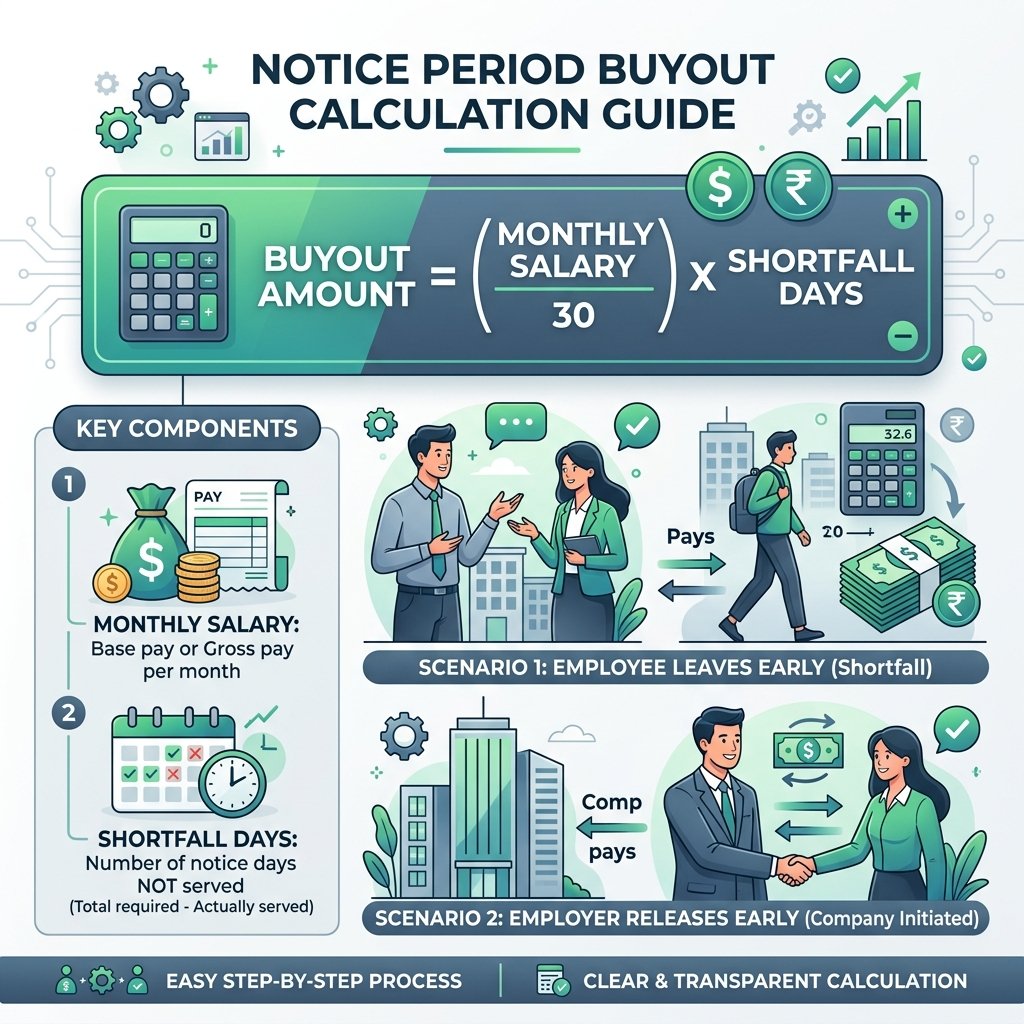
The Standard 30-Day Salary Formula
Notice buyout calculation is based on your monthly basic or gross salary (depending on company contract terms) divided by 30 calendar days:
Notice Buyout Penalty = (Monthly Salary ÷ 30) × Shortfall Days
- Monthly Salary Base: Most MNC contracts state basic salary for buyout calculations, though some companies enforce gross salary recovery. Always check your appointment clause.
- Calendar Days vs Working Days: Notice period is counted in calendar days (30 days/month), NOT 22 or 26 working days.
- Tax Implications of Buyout: If your new employer reimburses your notice buyout amount, that sum is taxable in your hands as a perquisite under Section 17(2) of the Indian Income Tax Act.
4. How to Calculate Last Working Date in Excel Formula
If you prefer calculating your exit date in Microsoft Excel or Google Sheets alongside our online Last Working Date Calculator, you can use these simple Excel formulas:
- Calendar Days Formula (Including Weekends):
=Resignation_Date + Notice_Days - Leave_Offset
Example: If Cell A2 has Resignation Date (e.g. 2026-08-01), B2 has 90 notice days, and C2 has 10 unutilized leaves offset, enter=A2+B2-C2. - Working Days Formula (Excluding Saturdays & Sundays):
=WORKDAY(Resignation_Date, Notice_Days - Leave_Offset)
This built-in Excel function automatically skips weekends and optional holiday lists.
5. Indian Labor Laws & Employee Rights During Resignation
Understanding statutory employee rights under Indian labor jurisprudence prevents unauthorized exploitation during the exit process:
- Right to Relieving Letter & Experience Certificate: Employers cannot permanently withhold service certificates or relieving letters once all contractual financial dues or buyout recoveries are settled.
- Full & Final (F&F) Settlement Timeline: As per recommended HR compliance standards, F&F settlements along with leave encashment and bonus payouts should be completed within 30 to 45 days of an employee's LWD.
- Leave Encashment Rights: Unutilized Earned Leaves (EL) or Privilege Leaves (PL) that are not offset against notice days must be encashed in your final settlement based on your daily basic salary formula.
6. Professional Resignation Email Templates (LWD & Notice Ready)
Copy and customize these professional resignation templates to send your notice email to HR and manager:
7. Frequently Asked Questions on Last Working Day Calculation
To calculate your Last Working Day (LWD), take your official date of resignation (the day you submitted your notice email to HR) and add your contractual notice period duration in calendar days (e.g. 30, 60, or 90 days). If you have approved Earned Leaves (EL) or Privilege Leaves (PL), subtract those leave days from your notice period count.
If your company HR policy permits leave offsetting during resignation, your unutilized Earned Leaves (EL) or Privilege Leaves (PL) can be deducted from your total notice period days. For example, if your notice period is 90 days and you offset 15 unutilized leaves, your actual required serving duration becomes 75 days, bringing your LWD 15 days earlier.
In almost all Indian corporate companies, IT firms, and MNCs, notice period salary and buyout calculations use a 30-day (or 31-day calendar month) denominator formula: (Monthly Gross Salary ÷ 30) × Shortfall Days. The 26-day rule is primarily restricted to factory workers under specific statutory labor acts.
If you signed an employment contract agreeing to a 90-day notice period, it is legally binding under contract law. However, if your employer mutually agrees to early release, leave offset, or notice period buyout, you can exit earlier. Unilateral breach without notice may lead to legal recovery or non-issuance of relieving documentation.
Under Indian labor guidelines and court rulings, an employer cannot permanently withhold your experience or relieving letter if you settle all outstanding dues or buyout penalties. However, failure to serve notice or pay the contractually required buyout can delay full & final (F&F) settlement clearance.
When an employee pays a notice buyout penalty to an employer, current Indian Income Tax rules under Section 192 do not automatically allow deduction of buyout amounts from taxable salary income unless approved in specific tribunal rulings. Conversely, if your new employer reimburses your buyout cost, that reimbursement is treated as taxable perquisite in your hands.
Yes! Unless your employment agreement specifically states 'working days', notice periods in India are calculated strictly in calendar days. Saturdays, Sundays, and official public holidays are all included in your 30, 60, or 90-day notice calculation.
The standard contractual notice period for confirmed permanent employees at top Indian IT services companies like TCS, Infosys, Wipro, Accenture, and Cognizant is 90 calendar days (3 months). Probationers usually have a 15 to 30-day notice period.